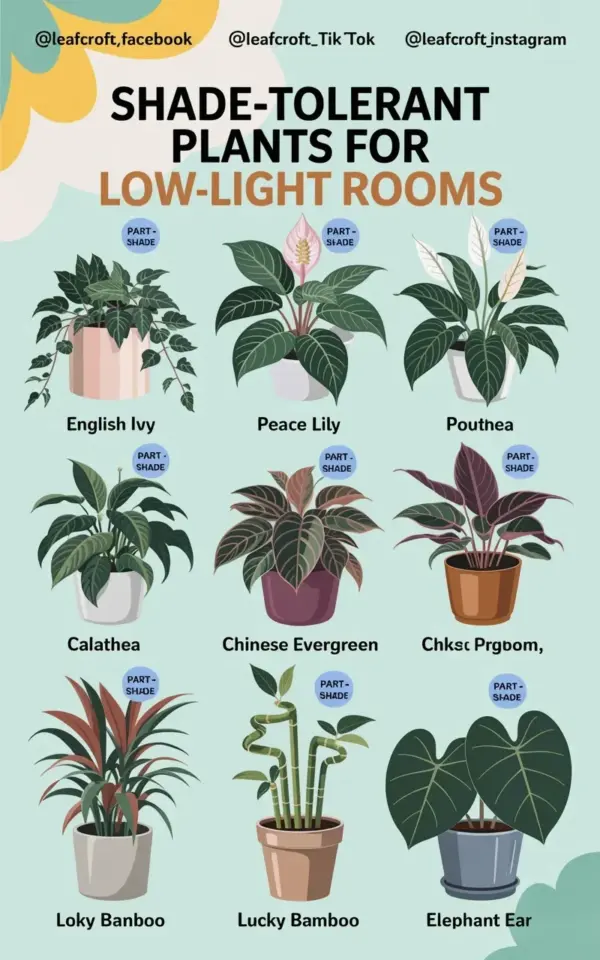
First things first: yes, you can have plants in that dark corner
I have a north-facing apartment that basically turns into a cave by 3 PM. For years I assumed I was stuck with fake plastic greenery and dusty silk flowers. Then I discovered shade-tolerant plants for low-light rooms actually exist, and they don’t require a degree in horticulture. Honestly, the biggest surprise? Some of them look better than the sun-hogging divas I used to buy. That Pinterest-style infographic you saw earlier (the one with the mint green background and the little yellow and white cloud in the top left corner) shows exactly six plants that changed my dark corners from sad to lush. The black text “@leafcroft_facebook” and “@leafcroft_tiktok” and “@leafcroft_instagram” at the top isn’t just branding, it’s a promise that these plants are worth sharing. So let’s walk through them, one weird personal opinion at a time.
Snake Plant: the indestructible guardian of neglected corners
Look, I know snake plants are everywhere. There’s a reason. They survive in rooms where even dust mites complain about low light. I put one in my bathroom that gets maybe two hours of indirect light per week, and it’s still pushing out new pups like it’s trying to populate the planet. Not gonna lie, I forget to water it for weeks sometimes. The leaves just sit there, tall and stiff, judging my forgetfulness. Here’s the thing: in low light, snake plants grow slower, which means they need even less water than you think. I water mine maybe once a month in winter. Overwatering in a dark corner is the fastest way to kill it. So if you tend to love your plants to death with the watering can, this one forgives you, but only if you back off.
Pothos: the trailing vine that won’t quit (or complain)
Pothos is the plant equivalent of that friend who’s fine with hanging out in a dimly lit dive bar. It doesn’t care. I have a golden pothos in a corner of my living room that gets zero direct light, and it’s trailing five feet down from a shelf. The leaves are a little smaller than they’d be in bright light, sure, but they’re still variegated and gorgeous. Quick tip: if the variegation starts fading to solid green in your low-light spot, don’t panic. That’s just the plant optimizing for survival. It’s still healthy. My cat once jumped up and bit a leaf out of spite, and the pothos just grew a new one. Honestly, I think it thrives on mild neglect and mild abuse. And here’s a random personal detail: I once tried to propagate a pothos cutting in a glass of water on a dark bookshelf. It took four months to grow roots, but it did. So patience works.
ZZ Plant: the one you can literally ignore for months
Ok so the ZZ plant is basically the introvert superhero of the plant world. It stores water in its thick potato-like rhizomes, so you can leave it alone for six weeks and it won’t even blink. I bought mine two years ago from a grocery store clearance rack, it had one droopy leaf and looked sad. Now it’s in a dark corner of my bedroom, and it has these gorgeous waxy leaves that reflect even the smallest sliver of light. It’s like it makes its own sunshine. The infographic mentions “quick tip: don’t overwater since they dry out slower in low light.” That’s the gospel right there. I only water my ZZ when the soil is completely dry, sometimes every three weeks in winter. One more thing: if your ZZ gets leggy and sparse, it’s actually reaching for more light. But even then, it’ll survive. This plant is the master of low expectations, and honestly, same.
Peace Lily: the drama queen that tells you when it’s thirsty
I know, I know, peace lilies are supposed to be finicky. But hear me out. In low light, they don’t bloom as much, but they still produce those elegant white spathes now and then. And the foliage is this deep, glossy green that brightens any dark corner. The real magic? Peace lilies are dramatic. When they need water, the leaves droop like they’re about to give a Shakespearean death speech. Then within an hour of watering, they perk back up. It’s like having a plant with a built-in moisture meter. I put one in my hallway that gets almost no light, and it just sits there looking content. Here’s the weird thing: I actually enjoy the drooping. It’s a clear signal. No guessing. No sticking your finger in the soil hoping for the best. Just pure botanical theater.
Cast Iron Plant: the name says it all
Honestly, if you kill a cast iron plant, you probably need to check your carbon monoxide detector. This thing is absurdly tough. Its leaves are thick and dark green, almost leathery, and they can tolerate deep shade that would turn most plants into brown twigs. I have one in a corner behind my TV that gets no direct light, maybe a few hours of reflected light from a window across the room. It’s been there for 18 months and hasn’t complained once. Water it when the soil is dry, maybe every two to three weeks in low light. That’s it. No fertilizing, no misting, no special treatment. It’s the plant equivalent of a cast iron skillet, ugly-duckling charm, but it lasts forever. And it’s one of those low-light houseplants that experienced growers recommend to beginners who think they have a black thumb.
Dracaena: the quiet statement piece for dark corners
I’ll admit, dracaenas are a little hit or miss in very low light depending on the variety. But the ‘Janet Craig’ and ‘Lisa’ cultivars are practically bulletproof in dim conditions. I have a ‘Janet Craig’ that stands about four feet tall in a corner that gets barely any light. It’s grown maybe a foot in two years, slow but steady. The leaves are dark green and slightly arching, it looks like a mini palm tree that went to a goth phase. Here’s a tip I learned the hard way: dracaenas are sensitive to fluoride in tap water. The leaf tips can turn brown. Use filtered water or let your tap water sit out overnight. That’s my one annoying maintenance tip. But otherwise, it’s an easy indoor plant that tolerates my unpredictable watering schedule. And it adds height to a room full of low-growing vines and tufts.
Bonus survival tips for all dark room plants (from someone who killed a fern in a closet)
- Water less. Seriously. In low light, the soil stays wet much longer. Stick your finger in the soil up to the second knuckle. If it’s damp, walk away. If it’s dry, then water. Your plants will thank you by not rotting.
- Dust the leaves. I know, boring chore. But in low light, every photon counts. Dust blocks what little light there is. Wipe leaves with a damp cloth every few months.
- Rotate your pots. Even that tiny sliver of light from your window can make a plant lean like it’s trying to catch a bus. Turn the pot a quarter each month to keep growth even.
- Watch for pests. Low light, low airflow = spider mites love that. Check the undersides of leaves. If you see tiny webs, isolate and treat with neem oil.
These dark room plants aren’t magic. But they’re about as low-maintenance as living greenery gets. And honestly, a little living green in a forgotten corner changes the whole vibe of a room. It’s like the plant is whispering, “I see you. I’m fine. We’re fine.”
Save this list and surprise yourself later
Look, I’m not going to tell you that every dark corner will become a jungle overnight. But these six plants, the snake plant, pothos, ZZ, peace lily, cast iron, and dracaena, are the real deal. They’ve survived my neglect, my overwatering phases, and my cat. If you’re scrolling through Pinterest and saw that mint green infographic with the cloud and the “@leafcroft” handles, now you know the details behind each plant. Houseplant tips like these are meant to be used, not just saved for later. So grab one (or three) next time you’re at the shop. Put it in that dim corner. Water it sparingly. Watch it live. And if you want more weird plant ramblings from someone who talks to her plants, well, you know where to find me.
#ShadeTolerantPlants #LowLightHouseplants #EasyIndoorPlants #DarkRoomPlants #HouseplantTips
Leave a Comment