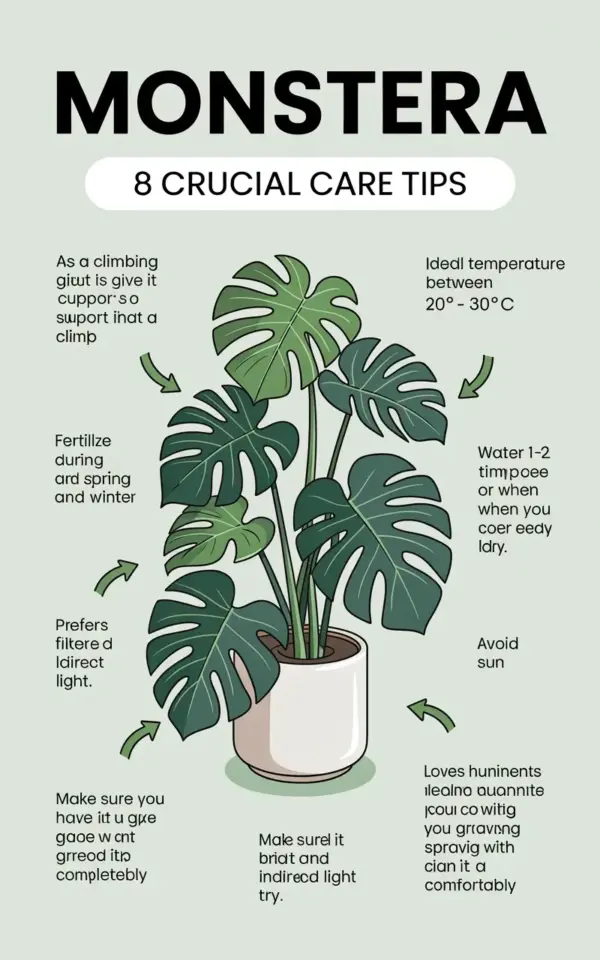
You picked up a Monstera deliciosa and now you’re staring at those big split leaves wondering if you can keep them looking that good. Honest answer. Yes you can. It’s not as fragile as people say. This Monstera deliciosa care guide breaks down the eight moves that actually keep your plant happy and fenestrated. I have killed enough houseplants to learn what works. So I’m just going to tell you straight. And look, that infographic you saw with the sage green background and the big bold “MONSTERA” text at the top? It’s got the right idea. The white pot, the dark green leaves, the little circular arrows around the plant. Those arrows aren’t just decoration. They’re survival shortcuts.
1. Give It Something to Climb (It’s a Sprawling Jungle Vibe, Not a Desktop Plant)
Here’s the thing. Monstera deliciosa is a climber. In the wild it scrambles up trees. You stick it in a corner with no support and those stems will flop sideways, snap, or just look sad. I learned this the hard way after my first Monstera turned into a floor-crawling mess. Get a moss pole. Or a coco coir pole. Even a piece of untreated wood if you’re in a pinch.
The infographic photo shows that little tip listed right near the top. “As a climbing plant, it is good to give it a support.” Yes. Do it. Tie the stems loosely with soft plant ties. Not tight. The aerial roots will grab the pole on their own eventually. And honestly, the leaves get bigger and those splits (the fenestrations) get way more dramatic when the plant feels like it’s climbing something real. It’s not optional. It’s the secret.
2. Bright Indirect Light (But Not Right Against a South Window, Please)
Everyone says bright indirect light. What does that actually mean? Look, a few feet away from a bright window is perfect. East or west facing is ideal. South facing is okay if you pull it back from the glass a bit. North facing? It might survive but don’t expect many split leaves. The leaves will stay solid, no fenestrations, and they might get leggy.
I have a friend who kept her Monstera in a dim hallway for six months. It grew three leaves. None of them had a single hole. She moved it to her living room near a sheer-curtained window and bam. The next leaf had two holes and a split. The infographic doesn’t lie about this one. The little green arrow for light is non-negotiable. One more thing. If the leaves start looking pale or bleached, you’re giving it too much direct sun. Move it back. They can sunburn. Not gonna lie, I have a crispy edge on one leaf from a sunbeam I didn’t notice. My fault.
3. Well-Draining Soil Is Not a Suggestion (It’s a Life or Death Thing for Roots)
Standard potting soil straight from the bag holds too much water. Monstera roots like air. They rot fast if they stay wet. So mix your own. Honestly, it’s easy. I use one part regular potting mix, one part perlite, and one part orchid bark. That’s it. The bark gives the chunky texture the roots love. The perlite keeps drainage open.
Here’s a short list of what works in a pinch:
- Two parts potting mix and one part perlite (basic but fine)
- Pre-made aroid mix from a plant shop (lazy and expensive but works)
- A handful of coco coir added for moisture balance if you live in a dry climate (I don’t bother)
- Literally just orchid bark mixed with potting soil if you’re out of perlite (it’ll survive)
The infographic photo has that white pot with well-draining soil implied. You need drainage holes too. Absolutely need them. No exceptions. If you have a cute pot without holes, use it as a cache pot and keep the Monstera in a plastic nursery pot inside it. I cannot stress this enough. Standing water kills faster than neglect.
4. Watering on a Schedule Will Mess You Up (Check the Soil Instead)
I used to water every Sunday like a robot. Lost two plants that way. Monstera likes to dry out a bit between waterings. Stick your finger in the soil about two inches deep. If it feels dry, water. If it feels damp, wait. That’s the whole trick. No calendar needed.
Here is the weird personal tangent. I once kept a Monstera in a bathroom with a tiny north-facing window and it grew three new leaves before I remembered to water it. Plants are weird. They do what they want. But generally, in brighter conditions you will water once a week or so. In lower light, maybe every ten to fourteen days. Consistency based on feel, not a date. And bottom watering? Sometimes I do it. Sometimes I pour from the top. I don’t think it matters that much as long as the water runs through the drainage holes. Let it drain completely. Don’t let it sit in a saucer of water. That’s just begging for root rot.
5. Humidity Helps but It’s Not a Deal-Breaker for Most Homes
People act like you need a greenhouse for a Monstera. You don’t. They tolerate average household humidity fine. But if you want those split leaves to open smoothly and not get stuck, a little extra humidity can help. I run a small humidifier near my plants in the winter when the heater dries everything out. It’s not fancy.
One tip from the infographic that often gets skipped: wipe the leaves. Dust clogs the pores. Monstera leaves are big and they collect dust like crazy. I wipe mine with a damp cloth every few weeks. Some people use neem oil or a bit of soapy water for pest prevention. I just use water. The leaves get shiny and the plant breathes better. And if you really want, you can put it in a bathroom while you shower. It likes the steam. I do this. It feels ridiculous but it works.
6. Pruning for Shape and Fenestrations (Yes, Cut Some Leaves Off)
Don’t be afraid to prune. A Monstera with too many small old leaves at the bottom will put energy into those instead of pushing out big new ones. Cut the sad ones off near the base. The plant will thank you with faster new growth that has more splits. I prune at the start of spring usually.
Also, if a leaf is damaged or yellowing, just remove it. It’s not coming back. Let it go. There is no saving a burned leaf. I have kept yellow leaves on plants out of guilt and it just slows everything down. Cut it off. The infographic photo shows a healthy plant with big dark green leaves. That’s not luck. That’s pruning decisions. And propagating the cuttings is a bonus. Stick a cutting with a node in water, wait a few weeks, and you have a new plant. Free Monstera. Who says no to that?
7. Feeding and Repotting: Less Is More (But Do It Right)
Fertilizer is not complicated. I use a balanced liquid houseplant fertilizer (something like a 20-20-20 or a 10-10-10) diluted to half strength once a month in spring and summer. I stop in fall and winter. The plant rests then. Overfeeding causes brown leaf tips. You don’t want that. It’s ugly.
Repotting is every one to two years. You will know it’s time when roots poke out of the drainage holes or the plant looks top-heavy. Go up one pot size. Not too big. A giant pot holds too much wet soil and root rot sneaks in. I learned that from a sad Monstera that went from a six-inch pot to a ten-inch pot in one jump. It sulked for months. Slow and steady. The infographic does not show a repotting tip directly but the healthy roots system is implied. Healthy roots mean healthy split leaves. That’s the foundation.
Look, the eight tips from that illustration are all here. Support, light, soil, water, humidity, cleaning, pruning, feeding. That’s the whole recipe. Miss one and the plant will still live. Miss too many and you get a sad, leggy Monstera with no splits. You don’t want that. Your plant deserves better. You deserve a plant that looks like a jungle queen. So try a moss pole. Check the soil with your finger. Stop watering on a schedule. Wipe dust off those big green leaves. And cut the ugly leaves off without guilt. Your Monstera will reward you with new leaves that have the holes you wanted. I promise. Now go save this pin and start.
#monsteracare #houseplanttips #monsteradeliciosa #plantcare #indoorgarden
Leave a Comment